

Choose Krishna wall art by the role the wall needs to play. A pooja-room piece should fit the available prayer area without competing with the mandir, while a living-room piece can act as the main focal point and be viewed comfortably from farther away. Measure the usable wall, note nearby furniture and decide whether you want a softly illuminated panel or a simpler metal composition before selecting the design.
Pooja room or living room: the quick decision
Choose the pooja room when the artwork will support a dedicated prayer setting and can be seen at close range. Keep the surrounding wall calm, leave clear space around the artwork and make sure doors, shelves, bells and other accessories will not overlap its outline.
Choose the living room when you want the Krishna artwork to anchor a larger wall above a console, sideboard or low cabinet. From a normal seating distance, a broader composition and stronger silhouette are easier to appreciate than many small decorative elements.
Start with usable wall space, not total wall size
Measure only the area the artwork can actually occupy. Exclude switchboards, curtain edges, doors, wall niches and tall furniture. If the piece will sit above a console, measure the furniture width as well as the clear height from its top to the ceiling or nearest shelf.
Mark the proposed outer edges with removable paper tape. Step back to the usual viewing point and check whether the shape feels balanced. This simple test is more reliable than imagining the product from a close-up photograph. For a complete measuring method, use KRAPHY’s guide to measuring wall space before buying metal wall art.
What works best in a compact pooja area?
A compact pooja area usually benefits from a clear central devotional image and fewer surrounding objects. Leave enough visual breathing room so flowers, a small diya tray or daily-use accessories do not hide the lower details of the artwork. If the mandir already has carved doors, bright fabric or several idols, choose a wall position that reduces competition rather than adding another dense layer.
For an artwork with integrated lighting, check the intended cable and connection route before drilling. The wire should reach the planned power point without crossing the devotional display. Follow the product instructions and use a qualified installer whenever electrical or mounting work is outside your experience.
What works best on a living-room focal wall?
In a living room, treat Krishna wall art as the main statement rather than one item in a crowded gallery. Centre it on the usable wall or align it with the furniture below. Keep tall lamps, vases and plant leaves away from important parts of the silhouette.
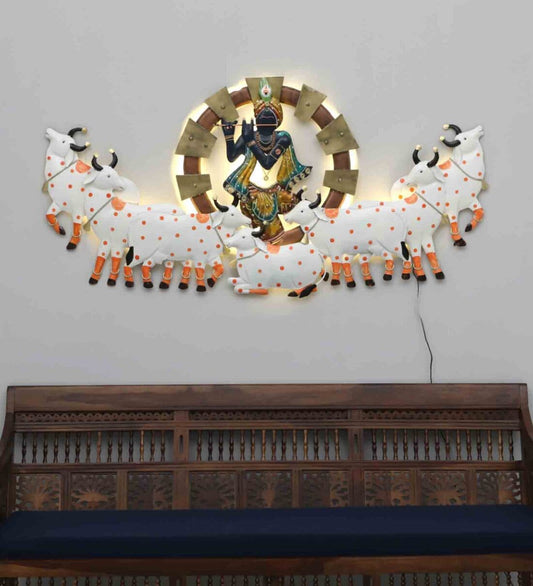
A neutral ivory, beige or warm-grey wall gives multicolour metalwork a calm background. Dark wood below the artwork can connect naturally with brown and antique-gold details. If your room already has patterned upholstery or bold curtains, repeat only one restrained colour from the artwork elsewhere in the room.
For broader room-planning ideas, see how to style metal wall art in a living room and the KRAPHY wall-decor guide for Indian homes.
LED wall art or non-LED metal art?
An LED design is useful when you want the artwork to create an evening focal point as well as a daytime decorative feature. Test the effect with the room’s main lights on and off. Place the piece where its glow will not reflect strongly in a television, mirror or glossy cabinet door.
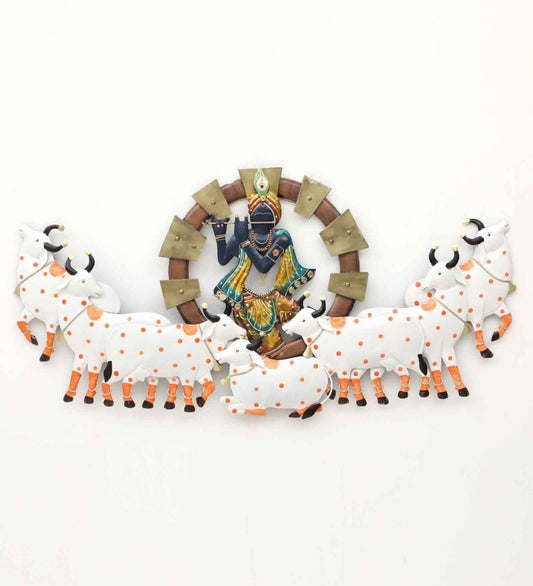
A non-LED metal composition is easier to integrate when the room already has layered lighting or when you prefer the metalwork itself to remain the focus. It can still look dimensional under a nearby warm wall washer or ceiling light, provided the fixture does not produce harsh glare.
Two KRAPHY options for different walls
A vertical illuminated composition
The KRAPHY Iron Radha Krishna in Multicolour with LED Wall Art is listed as a single religious wall piece measuring 22 inches long, 31 inches high and 1 inch broad. Its vertical orientation suits a wall with more height than width, such as a framed prayer niche, a narrow console wall or a defined living-room panel. Check the full 31-inch height against the usable wall before placing it above furniture.
A landscape pastoral composition
The Radha Krishna with Cows Under Tree Metal Wall Art is listed as a 24 × 18-inch metal wall piece. Its landscape proportions and detailed tree-and-cows scene can suit a wider wall zone where the complete composition is visible at once. It is a practical option when you want a devotional focal point without relying on an illuminated feature.
Use this five-point placement checklist
- Measure the usable rectangle: record clear width and height after excluding obstacles.
- Match the orientation: choose vertical art for taller zones and landscape art for wider zones.
- Check the viewing distance: confirm that important details remain readable from the doorway or main seat.
- Plan lighting and wiring: identify reflections, power access and safe cable routing before installation.
- Reduce surrounding clutter: let the devotional artwork remain the visual centre.
Common mistakes to avoid
- Choosing from a close-up product image without marking the real dimensions on the wall.
- Placing a large artwork where a door or curtain can touch it.
- Adding many small frames around an already detailed spiritual composition.
- Positioning an LED piece directly opposite a glossy television or mirror without checking reflections.
- Drilling before confirming the rear hanging point and the final visible height.
Final recommendation
For a pooja room, prioritise calm spacing, close-range visibility and a clean relationship with the mandir. For a living room, prioritise scale, alignment with the furniture and visibility from the main seating area. In both cases, make the decision from actual wall measurements and the artwork’s orientation—not from room labels alone.
Browse KRAPHY Krishna décor to compare current designs, product details and availability for your wall.


 How to Arrange a Three-Piece Musician Showpiece Set
 How High Should You Hang a Decorative Wall Clock?
 How to Choose Indoor Candle Holders for Your Table Size